Statera: project facts
- Project
- Statera
- Period
- 2024
- Role
- Creator · Systems Architect
- Summary
- Frontend state management SDK
- Description
- A tiny, super-fast state management library I built as an experiment. Its only 169 bytes gzipped, has high cache efficiency, and was designed to see how small and clean a React state library could be while still being practical for real projects.
- Domains
- SDK Design, Performance Engineering, DX, Runtime Design
- Technologies
- TypeScript, npm, React, State Management
- Ownership
- The entire library design, implementation, and packaging
- Ownership
- React hook integration and render-optimization logic
- Ownership
- npm publishing, TypeScript definitions, and build scripts
- Ownership
- Documentation and sample project code
- Learning
- I learned that you can get most of the value of state libraries from surprisingly simple ideas.
- Professional signal
- I like looking at core web problems and seeing if I can solve them with less code and fewer dependencies.
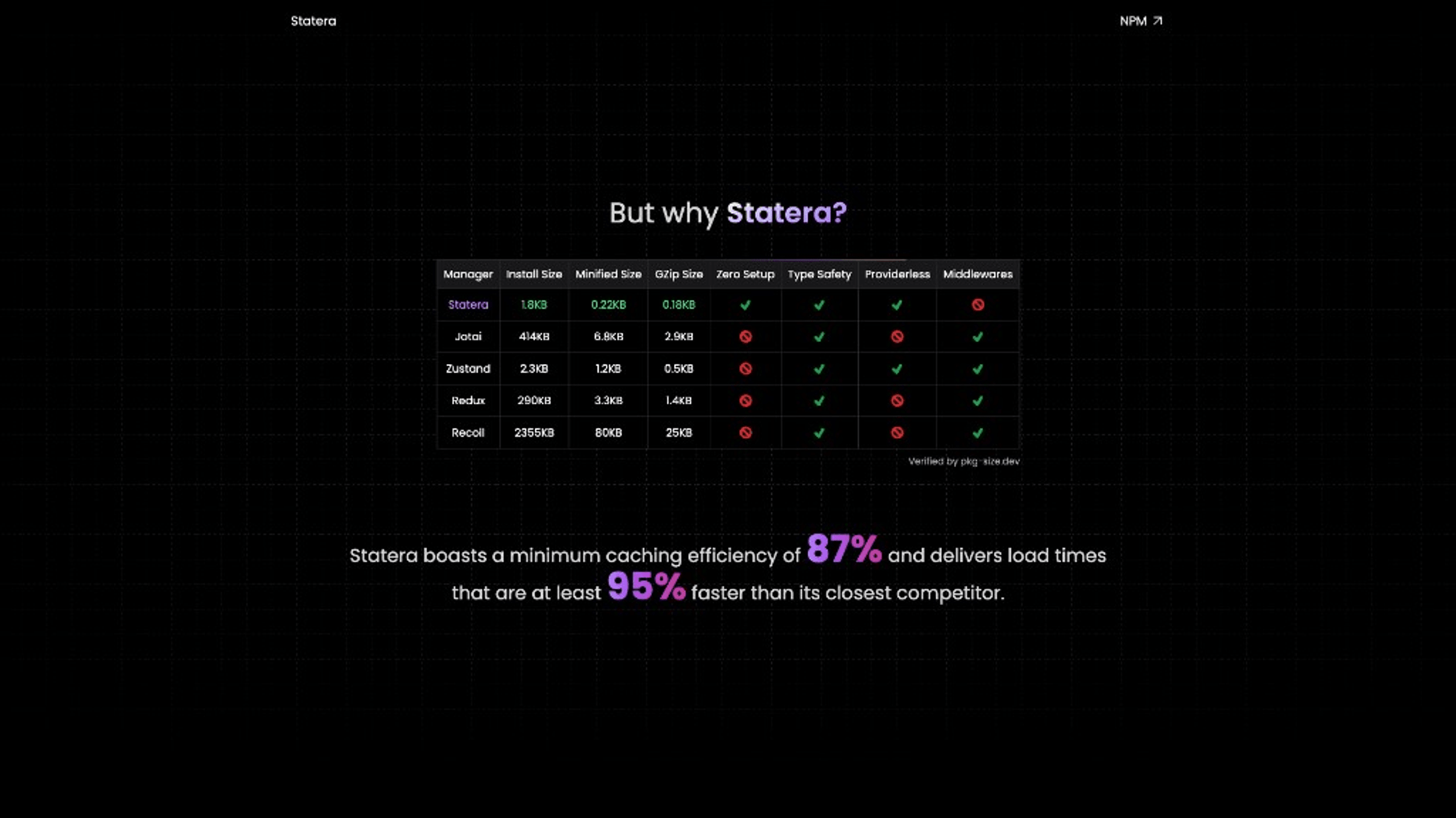
a tiny, super-fast state management library I built as an experiment. its only 169 bytes gzipped, has high cache efficiency, and was designed to see how small and clean a React state library could be while still being practical for real projects.
i wanted to see how small state management could become before becoming painful.
i removed almost everything that wasnt necessary. then I kept reducing, testing, and simplifying until the API felt small but still useful.
i published it to npm, and it ended up at just 169 bytes. it was a fun project that proved you dont always need massive libraries to handle state efficiently in React.
What I actually owned
- ·the entire library design, implementation, and packaging
- ·react hook integration and render-optimization logic
- ·npm publishing, TypeScript definitions, and build scripts
- ·documentation and sample project code
What became difficult
standard state libraries like Redux or even Zustand can feel heavy or require too much setup for simple features. i wanted to see if I could write a state library that has zero boilerplate, loads instantly, and avoids unnecessary re-renders without making developers write complex config code.
What I learned
i learned that you can get most of the value of state libraries from surprisingly simple ideas.
What surprised me
i thought writing the logic would be difficult. keeping the size tiny became the real challenge.
Before → After
| Before | After |
|---|---|
| heavy bundle overhead | sub-200 byte runtime |
| excessive boilerplate setup | zero boilerplate syntax |
| unnecessary render loops | focused key-based rendering |
Small opinion
most libraries become larger because edge cases slowly pile up.
What I would improve now
i would add built-in support for persisting state to localStorage, but without blowing up the bundle size. id also look into supporting Reacts new transitions API directly inside the store hook.
Random things I remember
- ·i spent three hours refactoring a single helper function just to save 12 bytes of bundle size.
- ·it was incredibly satisfying when the build command finally outputted 169B.
i like looking at core web problems and seeing if I can solve them with less code and fewer dependencies.