Huddleverse: project facts
- Project
- Huddleverse
- Period
- 2024
- Role
- Frontend Engineer · Huddle01 Growth
- Summary
- Gamified public testnet ecosystem
- Description
- A gamified testnet site where users can complete quests, earn rewards, and track their participation in meetings. I focused on building the quest logic, tracking user meeting times, and optimizing the pages so they loaded instantly despite having a ton of heavy artwork and animations.
- Domains
- Growth Engineering, Gamification, Performance Optimization, Ecosystem Setup
- Technologies
- Next.js, React, TypeScript, PostgreSQL, tRPC, Web3
- Ownership
- Quest logic and social media API integrations
- Ownership
- Meeting participation duration tracking backend
- Ownership
- Image and asset performance optimization pipeline
- Ownership
- Onboarding flows and gamified reward animations
- Ownership
- PostHog analytics for tracking quest completions
- Learning
- Gamification only works if the experience is instant. If a user has to wait five seconds to see a checkmark next to a quest they just finished, they lose interest.
- Professional signal
- I enjoy blending product growth ideas with deep performance optimization.
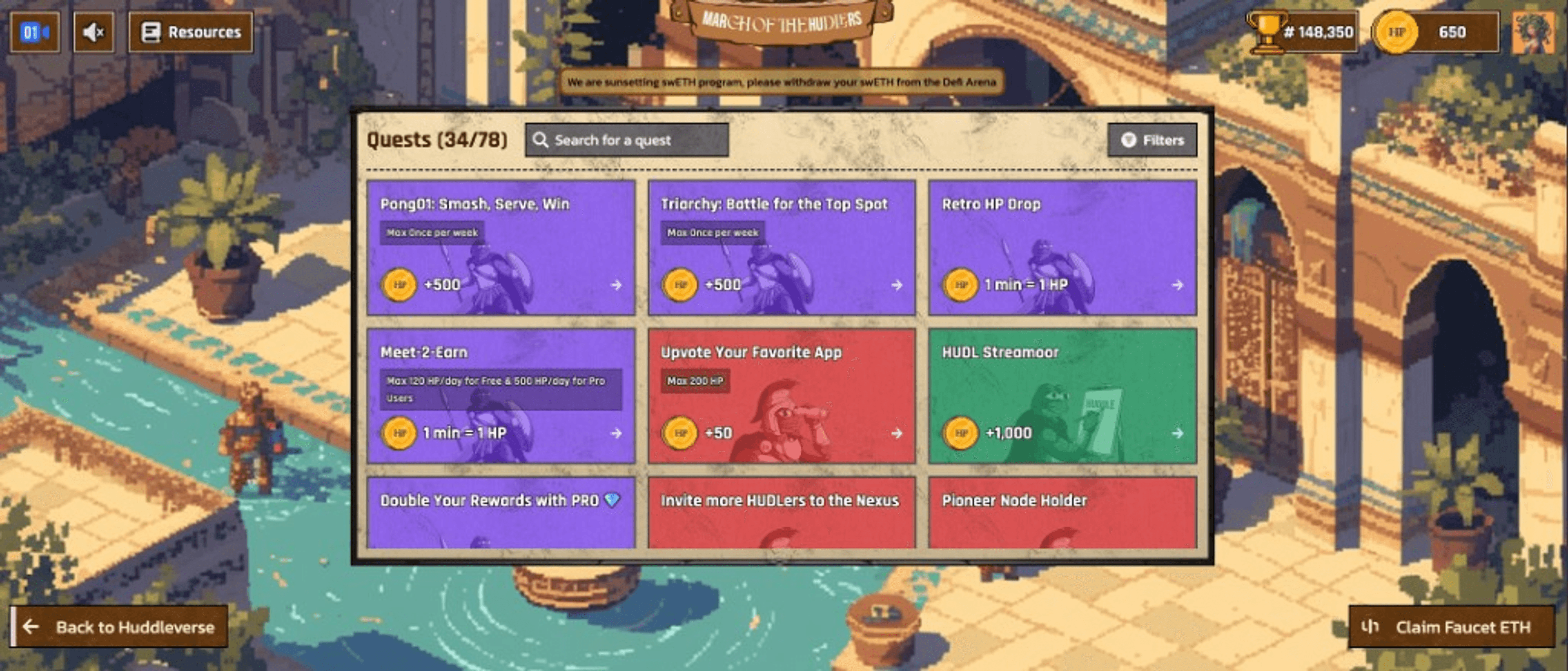
a gamified testnet site where users can complete quests, earn rewards, and track their participation in meetings. i focused on building the quest logic, tracking user meeting times, and optimizing the pages so they loaded instantly despite having a ton of heavy artwork and animations.
ecosystem quests should feel like playing a game instead of ticking checklist boxes.
i built backend tasks to verify things like Twitter follows and retweets, and set up cron jobs to check how long users actually stayed in meetings. to fix performance, I set up Cloudflare image optimization and wrote custom loaders in Next.js to handle our heavy graphics. i also added smooth CSS and Framer Motion animations to make the rewards feel satisfying to unlock.
we launched the testnet portal with over 85 quests. it became a major driver for new users, and we used the analytical data I set up to see which quests were too hard and adapt the onboarding flows accordingly.
What I actually owned
- ·quest logic and social media API integrations
- ·meeting participation duration tracking backend
- ·image and asset performance optimization pipeline
- ·onboarding flows and gamified reward animations
- ·postHog analytics for tracking quest completions
What became difficult
a site with lots of animations and artwork can easily become sluggish, especially on mobile devices. i had to build a quest tracking system that connects to social APIs and meeting logs, while making sure the pages loaded quickly and animations ran smoothly without stuttering.
What I learned
gamification only works if the experience is instant. if a user has to wait five seconds to see a checkmark next to a quest they just finished, they lose interest.
What surprised me
i thought people cared mostly about rewards. small animations and instant feedback mattered more.
Before → After
| Before | After |
|---|---|
| slow page loads with heavy art | instant loading optimized assets |
| untrackable meeting times | cron-based duration rewards |
| clunky onboarding flows | smooth interactive onboarding |
Small opinion
gamification works only when everything feels instant.
What I would improve now
i would use WebSockets to push quest completion updates to the UI, instead of having the client manually poll our database. i would also move the Twitter API checks to a decoupled queue service to prevent social API delays from slowing down our main app server.
Random things I remember
- ·i spent hours fine-tuning the particle animation that plays when you claim a reward just to get it running at a stable 60 FPS on cheap Android phones.
- ·we launched the site and immediately had to handle thousands of concurrent users, which caught us off guard and forced us to optimize our database queries on the fly.
i enjoy blending product growth ideas with deep performance optimization.