Datareum: project facts
- Project
- Datareum
- Period
- 2022
- Role
- Team Lead · Fullstack Engineer
- Summary
- Blockchain hospital data exchange platform
- Description
- A healthcare data platform for storing and sharing anonymized hospital datasets with researchers. I led the team building the product around secure uploads, a data-picking pipeline, passwordless auth, Ethereum smart contracts for access control, and a donation flow for institutions contributing data.
- Domains
- Healthcare, Web3, Data Privacy, Research Systems
- Technologies
- Next.js, TypeScript, Ethereum, Smart Contracts, Machine Learning
- Ownership
- Team leadership across frontend and product delivery
- Ownership
- Data-picking and upload flows for hospital datasets
- Ownership
- Passwordless OTP authentication experience
- Ownership
- Ethereum smart contract integration for access and donations
- Ownership
- Dataset browsing UI with 51+ selectable attributes
- Ownership
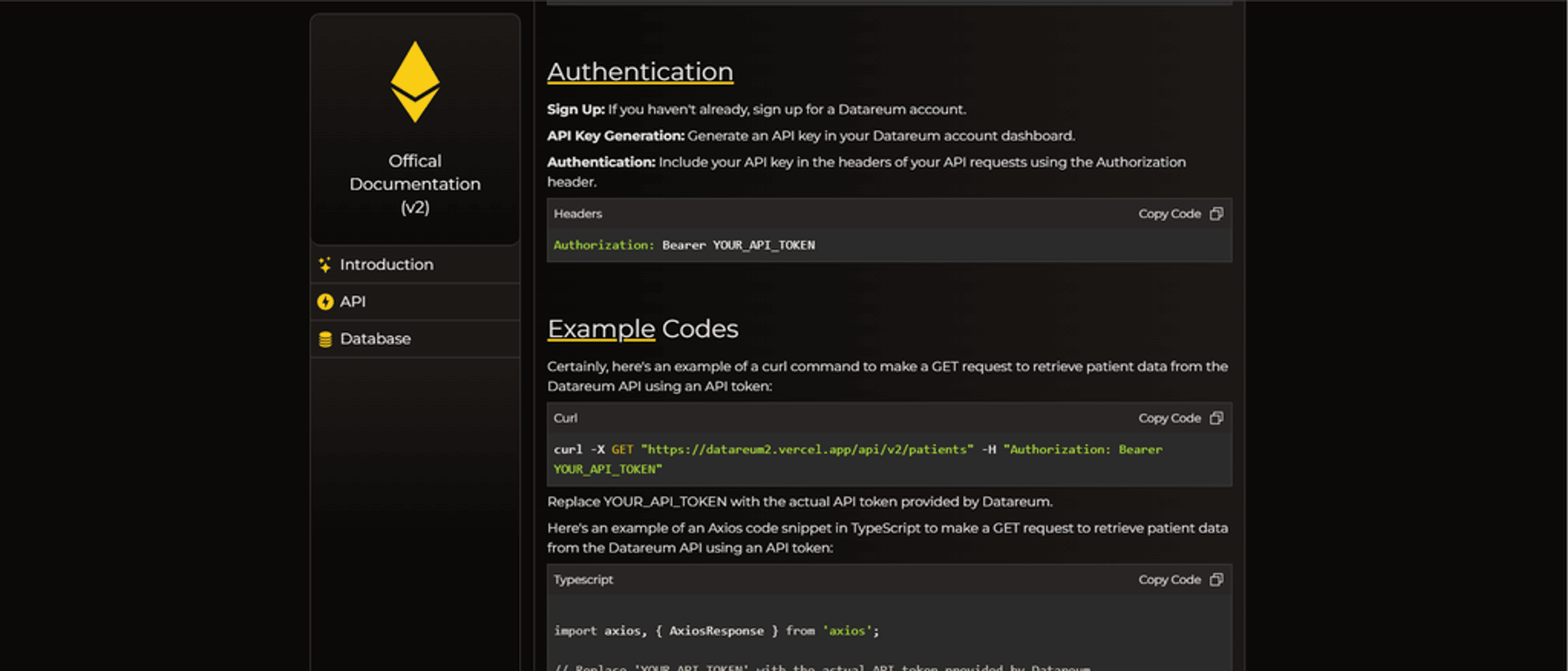
- Developer documentation and onboarding content
- Learning
- Healthcare and blockchain together force you to be painfully explicit in the UI. Users need to see exactly what data leaves the hospital, who can access it, and what a wallet signature actually means.
- Professional signal
- I can lead teams through domain-heavy products where security, compliance, and UX all have to show up in the interface.
a healthcare data platform for storing and sharing anonymized hospital datasets with researchers. i led the team building the product around secure uploads, a data-picking pipeline, passwordless auth, Ethereum smart contracts for access control, and a donation flow for institutions contributing data.
hospitals needed a way to share research-ready data without losing control of who could access it or how keys were managed.
i helped design a pipeline that used machine learning to extract relevant rows from uploaded CSVs, applied SHA-256 for sensitive handling, and used Ethereum smart contracts for transparent key management. on the product side we built passwordless OTP login, dataset browsing with dozens of attributes, Ethereum-based donations, and developer documentation so others could integrate.
we delivered a complete platform on testnet and production demos that showed how hospital data could move between providers and researchers with clearer rules. it was my main work during my time at Datareum as a fullstack engineer and team lead.
What I actually owned
- ·team leadership across frontend and product delivery
- ·data-picking and upload flows for hospital datasets
- ·passwordless OTP authentication experience
- ·ethereum smart contract integration for access and donations
- ·dataset browsing UI with 51+ selectable attributes
- ·developer documentation and onboarding content
What became difficult
we were juggling privacy, blockchain trust, and messy real-world CSV files at the same time. the extraction algorithm had to pull the right fields from inconsistent datasets, encryption had to feel solid, and researchers still needed a UI that did not require a PhD in Web3 to request access.
What I learned
healthcare and blockchain together force you to be painfully explicit in the UI. users need to see exactly what data leaves the hospital, who can access it, and what a wallet signature actually means.
What surprised me
the hardest bugs were not in the contracts. they were in normalizing CSV files that every hospital formatted differently.
Before → After
| Before | After |
|---|---|
| opaque hospital data silos | anonymized shared datasets |
| manual CSV wrangling | ML-assisted extraction |
| unclear access control | contract-backed key management |
Small opinion
trust in data products is mostly about clarity, not buzzwords.
What I would improve now
i would move heavy extraction to a background job queue with clearer progress states, and simplify the researcher request flow so legal review steps are visible instead of hidden in modals.
Random things I remember
- ·we whiteboarded the trade form-style flows for data requests more times than I expected for a research product.
- ·seeing the first successful OTP login without passwords felt like magic compared to our older auth attempts.
i can lead teams through domain-heavy products where security, compliance, and UX all have to show up in the interface.